
I was nervous walking into John Early’s new film, Maddie’s Secret. I’ve struggled with disordered eating for years at this point, and sometimes, in my bleaker moments, I joke about wanting to go on Ozempic. But luckily, Early’s film takes anorexia and bulimia seriously—even if it’s examined through a biting satire of food influencers and the Los Angeles scene.
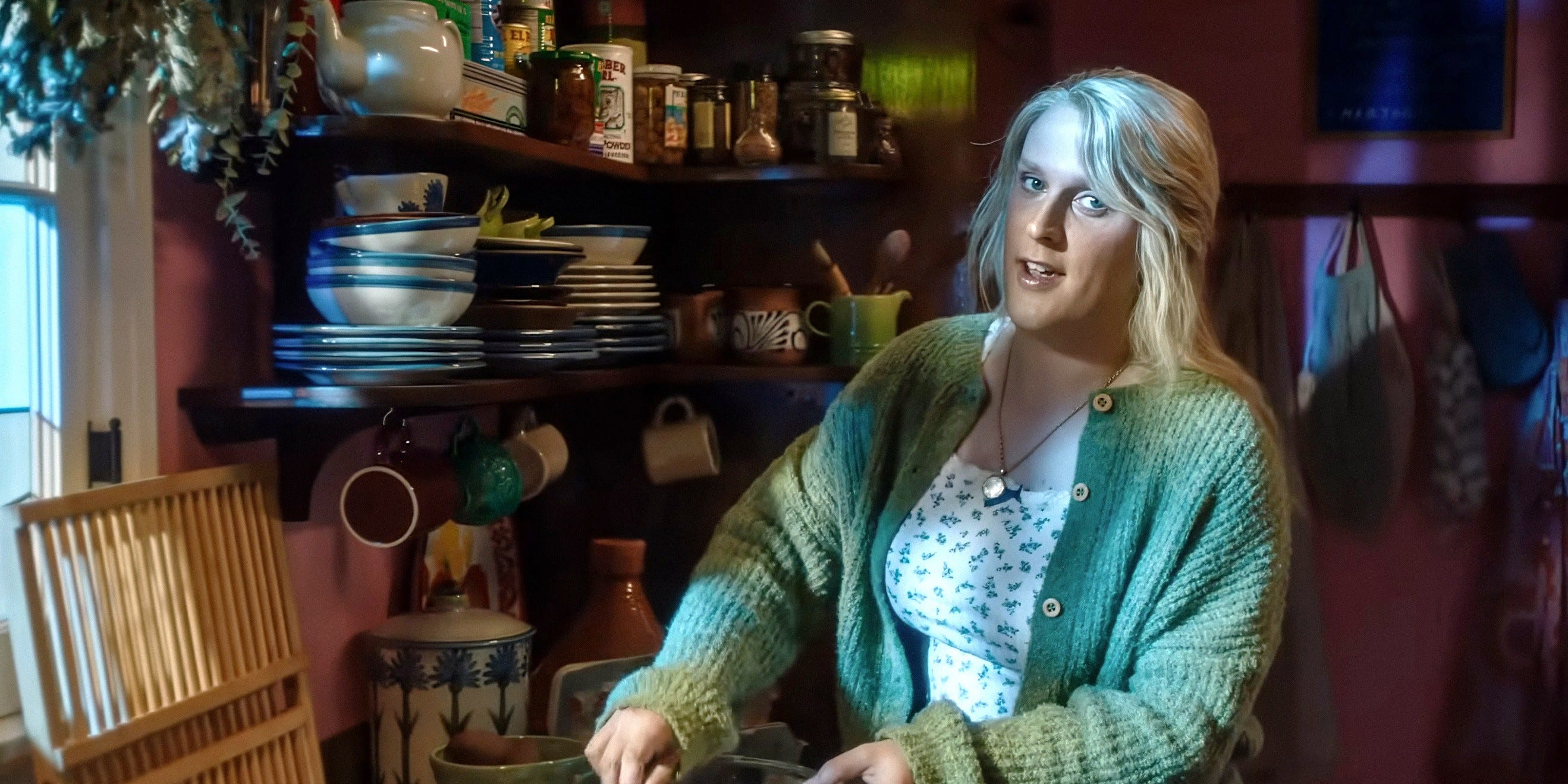
Maddie’s Secret is a tender portrait of a woman on the verge of a nervous breakdown. As Maddie, played lovingly by Early, ascends the world of online food royalty, she’s asked to interview for a job on The Boar, a Hulu original clearly poking fun at The Bear. Maddie becomes a “millennial Alice Waters” and a “vegetarian Nigella,” as her husband, Jake (Eric Rahill), dubs her. Early is also joined by Kate Berlant as Deena, a butch lesbian obsessed with Maddie; Claudia O’Doherty as Emily, the thinner, more conventional food influencer; Conner O’Mally as Maddie’s boss; and Vanessa Bayer as Julie, a woman whom Maddie meets in an inpatient eating-disorder clinic. All of the female characters have complicated, messy inner lives. In lesser hands, the maudlin drama would overwhelm the film, but Early treats his characters with sympathy, riding the line between genre and genuine insight. Yes, John Early plays a woman. But that’s not the joke.

“I don’t like the way I look,” Maddie mumbles early on as her husband tries to comfort her. The film both starts and ends with the starlet on the run, accompanied by a jangly score by Michael A. Hesslein. She’s struggling to be the good girl, both inside and out. When her husband calls her sexy, Maddie responds, “If by beautiful you mean puffy.” At her job at Gourmaybe, a content factory that churns out recipe videos, she feels an intense pressure to conform to traditional beauty standards—especially as she starts appearing on camera. When both she and others eat, the masterful sound design lingers painfully on ravenous chewing and gurgling crunches. It’s almost nauseatingly triggering. During a “radically inclusive” queer dance class, Maddie huffs and puffs until she’s contorting her body into painfully brisk poses. She’s afraid to let go of control.
Still, Early treats his women with respect, shooting them in beautiful lighting and gorgeous cinematography by Max Lakner. While the film calls to mind Todd Haynes’s Superstar, it shares as much DNA with May December as with cult classics like Clockwaters and Party Girl. There’s no easy morality lesson here.
In the age of Ozempic, eating disorders are not just about looks. As Maddie starts to gain confidence at her new job, she grows more anxious about how she appears on camera. Exercise and bulimia become her primary coping mechanisms. When Maddie finally collapses and faces mortal danger, she goes to a clinic and meets a group of young women struggling with similar food issues. The other women want control over their lives while understanding that their upbringing heavily influenced their relationship to eating. If it were just about wanting to lose weight, one of them says, you’d just go on Ozempic. But it’s not just about being skinny. That’s a facet of the disease, yes, but it’s also about desire, trauma, and fear.

Some may think that people bully each other less over their weight these days—that we’re in a fat-positive era—but Maddie’s Secret reminds us there’s still a push to looksmaxx. We’re obsessed with how we look and the kind of image we portray to our friends, potential suitors, and the omnipresent panopticon of the internet. Maddie is certainly still mocked about her weight, both online and by her coworkers. The language just looks different. “It’s really refreshing to see a food influencer with an actually healthy body,” one woman tells Maddie. Naturally, in response, she purges.
The movie takes a stirring turn when Maddie’s roommate Julie dies, succumbing to her tendency to overexercise and subsequently experiencing heart failure. Afterward, Maddie starts her recovery in earnest, even doing family therapy sessions with her mom (Kristen Johnston) and speaking at a private pagan memorial for her lost friend. Maddie’s not perfect. By the end, she has lied to and hurt both her husband and friends. (She even fakes a pregnancy.) These emotional moments show how much faith Early puts in his protagonist. We come to feel for her. Early on, the viewer experiences Maddie as a folksy, fun good girl who can’t quite verbalize her pain. After Julie passes, Maddie confesses she felt maternal toward her former roommate, wishing she could’ve protected her. Perhaps, she realizes, that safety is what she wanted her own mom to provide for her.
While Maddie’s Secret riffs on saccharine Lifetime movies, I found the moments when the audience laughed to be frustrating. People seemed to be laughing at John Early as Maddie, not with her. No one seemed to see past her breasts. Even painful moments of bulimia seemed to incur the audience’s laughter. But the film’s humor is not about Early playing a woman or her bulimia. Early noted in a Q&A after the film that he intentionally did not ever show Maddie vomiting. Instead, the comedy is more about the daily minutiae and intimately drawn character relationships.
Certainly, the film is in the canon of recent absurdist humor created by Nathan Fielder, John Wilson, Julio Torres, Connor O’Malley, Joe Pera, Patti Harrison, and Sarah Sherman. But this is, as Early said at the premiere, “a fairy tale in contemporary life.” It makes sense that the legendary Wallace Shawn is one of Early’s favorite directors and playwrights. There’s a political hue to Early’s work that plays on the farcical nature of modern life. In Maddie’s Secret, he’s crafted a rare gem: a funny but moving depiction of life with an eating disorder for the Ozempic era. Walking out of the theater, I felt relieved—and by the time I made it a few blocks away, I let out a long sigh. As much as I stressed about dinner, I still enjoyed my shawarma with relish.