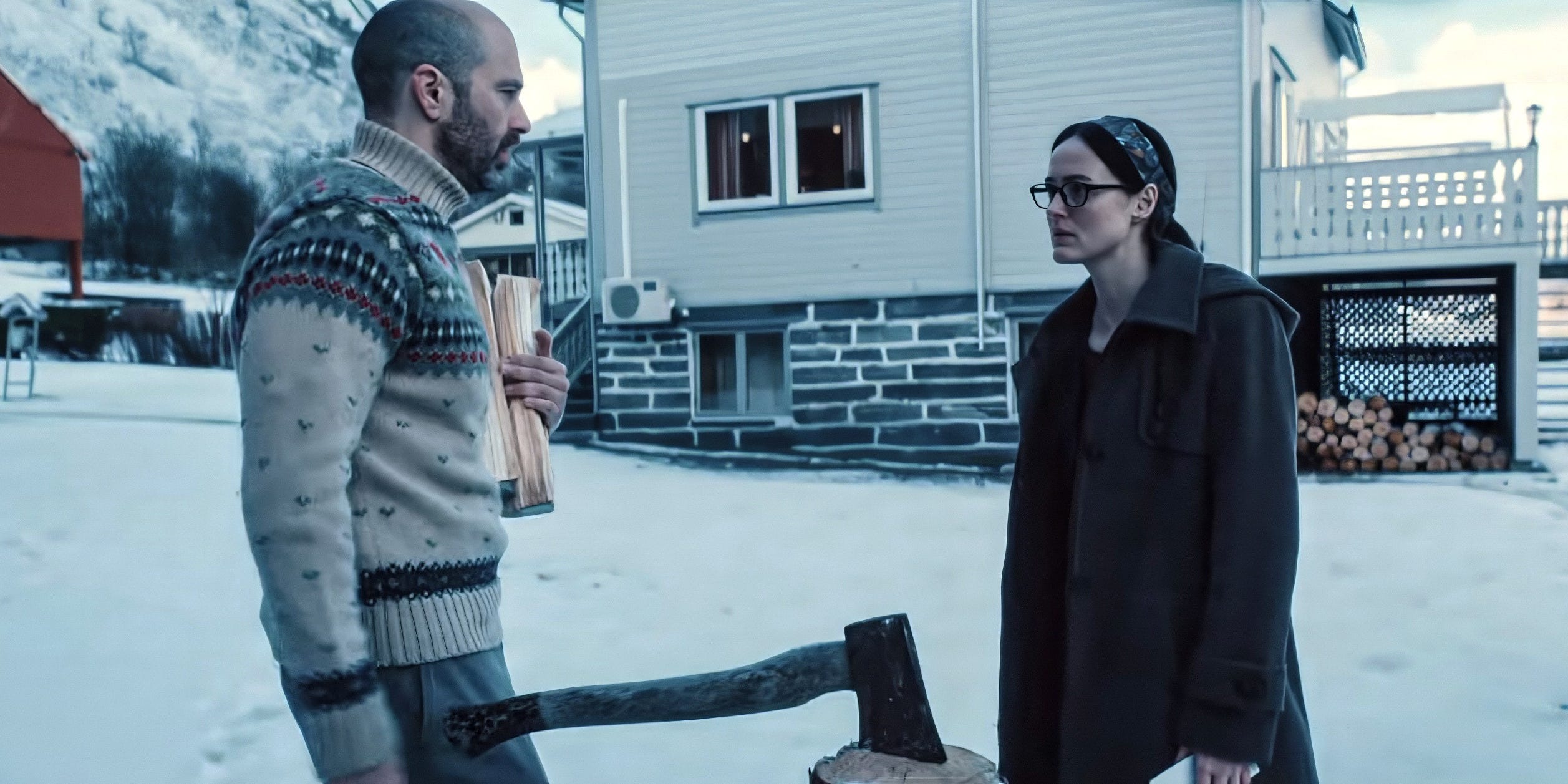

Romanian director Cristian Mungiu’s legal drama Fjord, which debuted at the 79th Cannes Film Festival in May and took home the festival’s top prize, the Palme d’Or, follows a married couple, Mihai Gheorghiu (Sebastian Stan) and his wife, Lisbet Gheorghiu (Renate Reinsve), who move from Romania to Norway with their five children. Following the deaths of Mihai’s parents, they relocate to be closer to Lisbet’s parents, who live in Norway and can help care for the kids, though the transition proves disorienting for the whole family. The Gheorghius are conservative Christians who initially gel well with the community they enmesh themselves in, even if their practices and beliefs — from singing worship music on the school piano to openly saying that marriage should only be between a man and a woman — grate against the more progressively minded members of the town. Though they might disagree on values, they can at least agree on the importance of hospitality and being good neighbors.
This early peace begins to fray and eventually reaches a breaking point when Child Protection Services receives a report from school administrators that some of the Gheorghius’ children arrived at class with bruises on their bodies, raising suspicions that Mihai and Lisbet might have abused them. Critically, Mungiu never shows exactly how the kids received the aforementioned bruises — or if they even did — and in several scenes prior, we see the oldest Gheorghiu children participate in a wrestling class for gym. When questioned by the police, Mihai admits that he occasionally “slaps” his children on the bottom as punishment and as a way to keep the children out of danger, while Lisbet confesses that she’s forcefully pushed her children out of the way when they were roughhousing in the kitchen to protect them from being burned by scalding water on the stove. The couple believes these to be normal behaviors, yet nonetheless, the CPS removes the children from their care in the name of safety.

Mihai and Lisbet suspect that the agency is discriminating against them because they are outsiders, using “child welfare” as a pretext to punish them for their religious beliefs. For their part, the townspeople want to take allegations of abuse seriously, while also wondering how healthy it is for children to grow up in a house that espouses values not just contrary to their own, but that they consider damaging to others.
Opening theatrically on October 9, Fjord is a film about the rigidity of bureaucracy and how, no matter who is in power, there is something about being a part of the majority that makes it difficult to have empathy for the minority. Mungiu has shared, though, that his film is less concerned with declaring one side right than with examining how even a society like Norway, which prides itself on protecting children and doing the right thing, can use its power to impose its own values. “Will this majority be more tolerant or understanding and inclusive because these are their values? They might not be. They might behave as any majority trying to impose the point of view of the majority on the others. This tells you that this way of thinking is not so different if it goes to the extremes,” Mungiu recently shared in an interview after the film’s premiere at the Telluride Film Festival.

The True Story Behind Fjord
While he does not offer easy answers, Mungiu roots his story in the real-life experience of Ruth and Marius Bodnariu, a young couple who moved from Romania to Norway around two decades ago. It is not a direct retelling — for starters, the impetus for Marius and Ruth’s move back to Norway was to start a family, whereas Mihai and Lisbet move to Norway so they can rely on Lisbet’s parents for childcare help — but what happened to the Bodnariu family acts as the spine for the director’s provocations.
In November 2015, Ruth and Marius were living in Naustdal, Norway, where, like Mihai and Lisbet in the film, Marius worked as an IT engineer and Ruth as a nurse. One day, while waiting for their two daughters to come home from school, Ruth received a visit from child protection services, who informed her that the girls were in emergency state care and that her two sons would also have to be removed from the couple’s care. Marius and Ruth later learned that the school principal had suspected them of spanking their children after one of their daughters mentioned she had been slapped. Acting on this information, Child Protection Services moved quickly to remove the daughters from Marius’s and Ruth’s care. The next day, the agency also took the couple’s infant. The five children were ultimately split across three different sets of foster parents, leaving Marius and Ruth to make eight-hour round trips to visit their baby and travel to a separate location to see their older sons.
The case drew significant international attention and sparked widespread protests, with Romanian and Norwegian communities rallying in support of the Bodnariu family. After months of legal proceedings, the children were gradually returned to their parents’ care — a resolution that Mungiu uses as a departure point to ask harder questions about power, cultural difference, and the limits of institutional authority that no court ruling can fully answer.